If You Know the Height You Know the Time of Flight
Basic Equations and Parabolic Path
Projectile motion is a form of movement where an object moves in parabolic path; the path that the object follows is called its trajectory.
Learning Objectives
Appraise the result of bending and velocity on the trajectory of the projectile; derive maximum tiptop using displacement
Primal Takeaways
Key Points
- Objects that are projected from, and land on the same horizontal surface will have a vertically symmetrical path.
- The time information technology takes from an object to be projected and land is called the time of flying. This depends on the initial velocity of the projectile and the angle of projection.
- When the projectile reaches a vertical velocity of zero, this is the maximum summit of the projectile then gravity will take over and accelerate the object down.
- The horizontal deportation of the projectile is called the range of the projectile, and depends on the initial velocity of the object.
Key Terms
- trajectory: The path of a body equally information technology travels through infinite.
- symmetrical: Exhibiting symmetry; having harmonious or proportionate organisation of parts; having corresponding parts or relations.
Projectile Motion
Projectile motion is a grade of movement where an object moves in a bilaterally symmetrical, parabolic path. The path that the object follows is called its trajectory. Projectile move only occurs when there is one forcefulness applied at the beginning on the trajectory, afterwards which the only interference is from gravity. In a previous atom we discussed what the various components of an object in projectile motion are. In this atom we will discuss the basic equations that go along with them in the special case in which the projectile initial positions are nothing (i.due east. [latex]\text{ten}_0 = 0[/latex] and [latex]\text{y}_0 = 0[/latex] ).
Initial Velocity
The initial velocity can be expressed equally x components and y components:
[latex]\text{u}_\text{ten} = \text{u} \cdot \cos\theta \\ \text{u}_\text{y} = \text{u} \cdot \sin\theta[/latex]
In this equation, [latex]\text{u}[/latex] stands for initial velocity magnitude and [latex]\minor{\theta}[/latex] refers to projectile bending.
Fourth dimension of Flight
The time of flight of a projectile motion is the time from when the object is projected to the time it reaches the surface. As we discussed previously, [latex]\text{T}[/latex] depends on the initial velocity magnitude and the angle of the projectile:
[latex]\displaystyle {\text{T}=\frac{ii \cdot \text{u}_\text{y}}{\text{g}}\\ \text{T}=\frac{2 \cdot \text{u} \cdot \sin\theta}{\text{thou}}}[/latex]
Acceleration
In projectile motion, there is no acceleration in the horizontal direction. The acceleration, [latex]\text{a}[/latex], in the vertical direction is just due to gravity, as well known as free fall:
[latex]\displaystyle {\text{a}_\text{10} = 0 \\ \text{a}_\text{y} = -\text{g}}[/latex]
Velocity
The horizontal velocity remains constant, but the vertical velocity varies linearly, considering the acceleration is constant. At any time, [latex]\text{t}[/latex], the velocity is:
[latex]\displaystyle {\text{u}_\text{ten} = \text{u} \cdot \cos{\theta} \\ \text{u}_\text{y} = \text{u} \cdot \sin {\theta} - \text{yard} \cdot \text{t}}[/latex]
You can besides use the Pythagorean Theorem to find velocity:
[latex]\text{u}=\sqrt{\text{u}_\text{x}^2+\text{u}_\text{y}^2}[/latex]
Displacement
At time, t, the deportation components are:
[latex]\displaystyle {\text{x}=\text{u} \cdot \text{t} \cdot \cos\theta\\ \text{y}=\text{u} \cdot \text{t} \cdot \sin\theta-\frac12\text{gt}^two}[/latex]
The equation for the magnitude of the displacement is [latex]\Delta \text{r}=\sqrt{\text{x}^2+\text{y}^two}[/latex].
Parabolic Trajectory
Nosotros tin can employ the deportation equations in the x and y management to obtain an equation for the parabolic form of a projectile motion:
[latex]\displaystyle \text{y}=\tan\theta \cdot \text{x}-\frac{\text{g}}{2 \cdot \text{u}^two \cdot \cos^2\theta} \cdot \text{x}^2[/latex]
Maximum Height
The maximum tiptop is reached when [latex]\text{five}_\text{y}=0[/latex]. Using this we can rearrange the velocity equation to find the time it will take for the object to reach maximum summit
[latex]\displaystyle \text{t}_\text{h}=\frac{\text{u} \cdot \sin\theta}{\text{g}}[/latex]
where [latex]\text{t}_\text{h}[/latex] stands for the time it takes to reach maximum pinnacle. From the displacement equation we can discover the maximum tiptop
[latex]\displaystyle \text{h}=\frac{\text{u}^2 \cdot \sin^two\theta}{ii\cdot \text{g}}[/latex]
Range
The range of the motion is fixed by the condition [latex]\modest{\sf{\text{y} = 0}}[/latex]. Using this nosotros can rearrange the parabolic motion equation to find the range of the move:
[latex]\displaystyle \text{R}=\frac{\text{u}^ii \cdot \sin2\theta}{\text{grand}}[/latex].
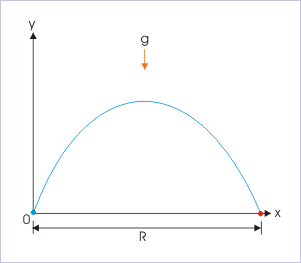
Range of Trajectory: The range of a trajectory is shown in this figure.
Solving Problems
In projectile motion, an object moves in parabolic path; the path the object follows is called its trajectory.
Learning Objectives
Place which components are essential in determining projectile motility of an object
Key Takeaways
Key Points
- When solving problems involving projectile movement, we must recall all the central components of the motion and the basic equations that proceed with them.
- Using that data, we can solve many different types of problems every bit long as nosotros tin analyze the information we are given and use the basic equations to figure it out.
- To articulate 2 posts of equal height, and to figure out what the distance betwixt these posts is, we demand to think that the trajectory is a parabolic shape and that there are two unlike times at which the object will reach the height of the posts.
- When dealing with an object in projectile motion on an incline, we starting time need to use the given information to reorientate the coordinate system in order to accept the object launch and fall on the same surface.
Fundamental Terms
- reorientate: to orientate anew; to cause to confront a unlike direction
We have previously discussed projectile motion and its key components and basic equations. Using that information, we can solve many problems involving projectile motility. Before we do this, allow's review some of the key factors that will go into this trouble-solving.
What is Projectile Motion?
Projectile movement is when an object moves in a bilaterally symmetrical, parabolic path. The path that the object follows is called its trajectory. Projectile motion only occurs when there is 1 forcefulness applied at the starting time, after which the only influence on the trajectory is that of gravity.
What are the Primal Components of Projectile Movement?
The primal components that we demand to think in order to solve projectile motion issues are:
- Initial launch angle, [latex]\theta[/latex]
- Initial velocity, [latex]\text{u}[/latex]
- Time of flying, [latex]\text{T}[/latex]
- Acceleration, [latex]\text{a}[/latex]
- Horizontal velocity, [latex]\text{five}_\text{x}[/latex]
- Vertical velocity, [latex]\text{v}_\text{y}[/latex]
- Displacement, [latex]\text{d}[/latex]
- Maximum superlative, [latex]\text{H}[/latex]
- Range, [latex]\text{R}[/latex]
Now, let's look at two examples of problems involving projectile motility.
Examples
Case 1
Permit'southward say you are given an object that needs to clear two posts of equal height separated by a specific distance. Refer to for this example. The projectile is thrown at [latex]25\sqrt{ii}[/latex] m/s at an angle of 45°. If the object is to clear both posts, each with a elevation of 30m, find the minimum: (a) position of the launch on the ground in relation to the posts and (b) the separation between the posts. For simplicity'south sake, use a gravity abiding of 10. Problems of any type in physics are much easier to solve if you listing the things that you know (the "givens").
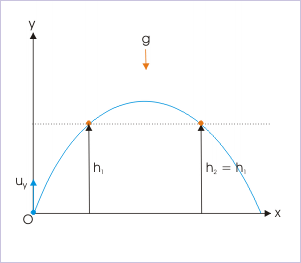
Diagram for Case ane: Utilize this effigy as a reference to solve example 1. The trouble is to brand sure the object is able to clear both posts.
Solution: The showtime thing nosotros demand to exercise is effigy out at what fourth dimension [latex]\text{t}[/latex] the object reaches the specified acme. Since the motility is in a parabolic shape, this will occur twice: in one case when traveling upward, and once again when the object is traveling down. For this we can use the equation of displacement in the vertical direction, [latex]\text{y}-\text{y}_0[/latex] :
[latex]\text{y}-\text{y}_0=(\text{5}_\text{y}\cdot \text{t})-(\frac{1}{ii}\cdot \text{g}\cdot {\text{t}^2})[/latex]
We substitute in the advisable variables:
[latex]\text{v}_\text{y}=\text{u}\cdot \sin\theta = 25\sqrt{ii} \text{ one thousand/s} \cdot \sin\ 45^{\circ}=25 \text{ m/s}[/latex]
Therefore:
[latex]30 \text{thou} = 25\cdot \text{t}-\frac{1}{ii}\cdot 10\cdot {\text{t}^2}[/latex]
We can employ the quadratic equation to find that the roots of this equation are 2s and 3s. This ways that the projectile will reach 30m afterward 2s, on its way up, and after 3s, on its way downward.
Case 2
An object is launched from the base of an incline, which is at an angle of 30°. If the launch angle is threescore° from the horizontal and the launch speed is ten m/s, what is the total flying time? The following data is given: [latex]\text{u}=10 \frac{\text{m}}{\text{s}}[/latex]; [latex]\theta = lx[/latex]°; [latex]\text{g} = ten \frac{\text{g}}{\text{s}^ii}[/latex].
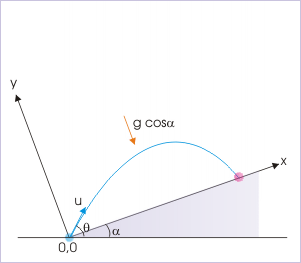
Diagram for Example two: When dealing with an object in projectile motion on an incline, we commencement demand to use the given information to reorient the coordinate organisation in gild to have the object launch and fall on the same surface.
Solution: In social club to business relationship for the incline angle, we have to reorient the coordinate system so that the points of projection and return are on the same level. The angle of project with respect to the [latex]\text{x}[/latex] direction is [latex]\theta - \alpha[/latex], and the acceleration in the [latex]\text{y}[/latex] direction is [latex]\text{g}\cdot \cos{\alpha}[/latex]. We supersede [latex]\theta[/latex] with [latex]\theta - \alpha[/latex] and [latex]\text{g}[/latex] with [latex]\text{g} \cdot \cos{\blastoff}[/latex]:
[latex]\displaystyle{{\text{T}=\frac{ii\cdot \text{u}\cdot \sin(\theta)}{\text{grand}}=\frac{two\cdot \text{u}\cdot \sin(\theta-\blastoff)}{\text{1000}\cdot \cos(\alpha)}=\frac{2\cdot 10\cdot \sin(60-xxx)}{10\cdot \cos(30)}}=\frac{20\cdot \sin(30)}{10\cdot \cos(30)}\\ \text{T}=\frac2{\sqrt3}\text{due south}}[/latex]
Cipher Launch Angle
An object launched horizontally at a superlative [latex]\text{H}[/latex] travels a range [latex]\text{5}_0 \sqrt{\frac{2\text{H}}{\text{g}}}[/latex] during a fourth dimension of flight [latex]\text{T} = \sqrt{\frac{2\text{H}}{\text{g}}}[/latex].
Learning Objectives
Explicate the human relationship between the range and the time of flight
Key Takeaways
Key Points
- For the zero launch angle, at that place is no vertical component in the initial velocity.
- The elapsing of the flight earlier the object hits the ground is given every bit T = \sqrt{\frac{2H}{g}}.
- In the horizontal direction, the object travels at a constant speed 50 during the flying. The range R (in the horizontal direction) is given as: [latex]\text{R}= \text{v}_0 \cdot \text{T} = \text{v}_0 \sqrt{\frac{ii\text{H}}{\text{thou}}}[/latex].
Cardinal Terms
- trajectory: The path of a body every bit it travels through infinite.
Projectile motion is a grade of motion where an object moves in a parabolic path. The path followed past the object is chosen its trajectory. Projectile motion occurs when a strength is applied at the first of the trajectory for the launch (subsequently this the projectile is subject area just to the gravity).
I of the key components of the projectile motion, and the trajectory it follows, is the initial launch bending. The angle at which the object is launched dictates the range, elevation, and time of flight the object will feel while in projectile motion. shows different paths for the aforementioned object being launched at the aforementioned initial velocity and different launch angles. Every bit illustrated by the figure, the larger the initial launch bending and maximum height, the longer the flight fourth dimension of the object.
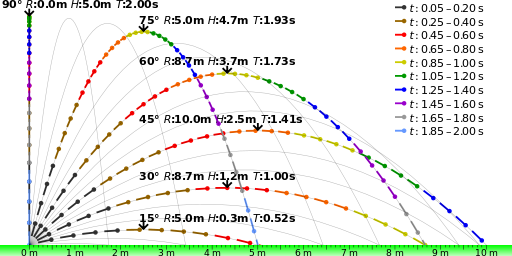
Projectile Trajectories: The launch angle determines the range and maximum top that an object volition experience afterward being launched.This image shows that path of the aforementioned object being launched at the same speed merely dissimilar angles.
We take previously discussed the effects of different launch angles on range, height, and time of flight. Nonetheless, what happens if there is no angle, and the object is just launched horizontally? It makes sense that the object should be launched at a certain height ([latex]\text{H}[/latex]), otherwise it wouldn't travel very far before hitting the ground. Let'due south examine how an object launched horizontally at a height [latex]\text{H}[/latex] travels. In our instance is when [latex]\alpha[/latex] is 0.
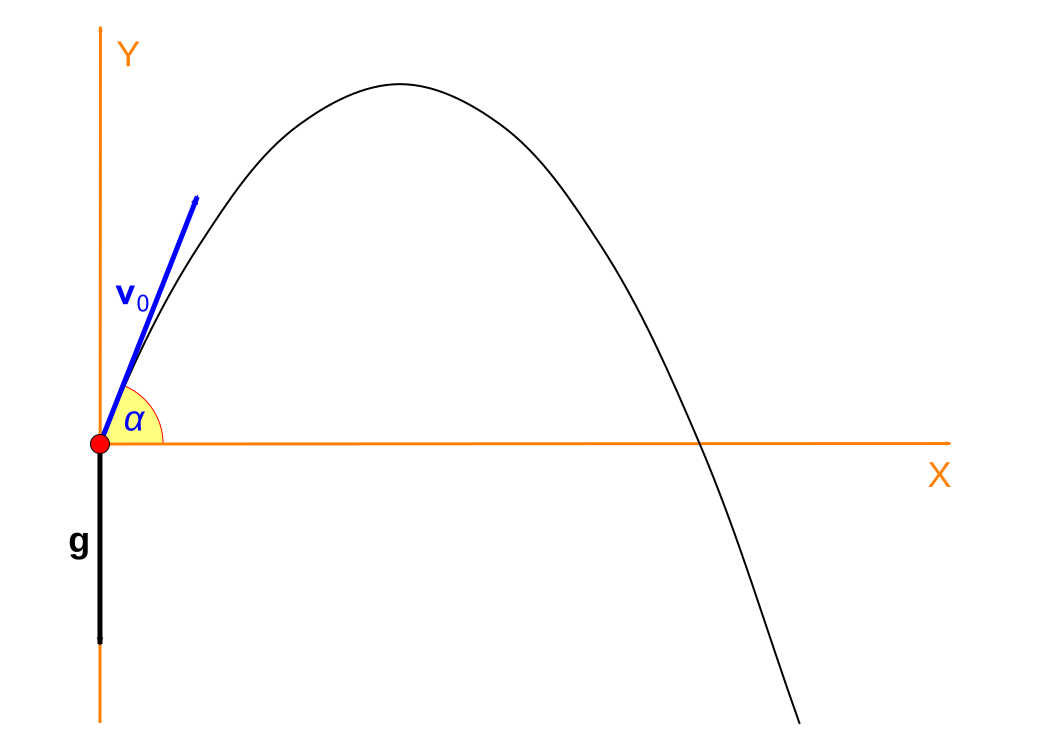
Projectile move: Projectile moving following a parabola.Initial launch bending is [latex]\blastoff[/latex], and the velocity is [latex]\text{v}_0[/latex].
Duration of Flight
In that location is no vertical component in the initial velocity ([latex]\text{v}_0[/latex]) considering the object is launched horizontally. Since the object travels distance [latex]\text{H}[/latex] in the vertical direction before it hits the footing, we can employ the kinematic equation for the vertical motion:
[latex](\text{y}-\text{y}_0) = -\text{H} = 0\cdot \text{T} - \frac{1}{2} \text{grand} \text{T}^2[/latex]
Hither, [latex]\text{T}[/latex] is the duration of the flight before the object its the footing. Therefore:
[latex]\displaystyle \text{T} = \sqrt{\frac{2\text{H}}{\text{g}}}[/latex]
Range
In the horizontal direction, the object travels at a abiding speed [latex]\text{five}_0[/latex] during the flight. Therefore, the range [latex]\text{R}[/latex] (in the horizontal direction) is given as:
[latex]\displaystyle \text{R}= \text{five}_0 \cdot \text{T} = \text{v}_0 \sqrt{\frac{2\text{H}}{\text{thousand}}}[/latex]
General Launch Angle
The initial launch angle (0-90 degrees) of an object in projectile motion dictates the range, elevation, and time of flight of that object.
Learning Objectives
Cull the appropriate equation to find range, maximum height, and fourth dimension of flight
Key Takeaways
Key Points
- If the aforementioned object is launched at the same initial velocity, the height and time of flight will increase proportionally to the initial launch angle.
- An object launched into projectile motion will have an initial launch angle anywhere from 0 to 90 degrees.
- The range of an object, given the initial launch angle and initial velocity is establish with: [latex]\text{R}=\frac{\text{five}_\text{i}^2 \sin2\theta_\text{i}}{\text{g}}[/latex].
- The maximum height of an object, given the initial launch angle and initial velocity is found with:[latex]\text{h}=\frac{\text{5}_\text{i}^ii\sin^2\theta_\text{i}}{ii\text{k}}[/latex].
- The fourth dimension of flying of an object, given the initial launch angle and initial velocity is found with: [latex]\text{T}=\frac{2\text{v}_\text{i}\sin\theta}{\text{k}}[/latex].
- The bending of achieve is the angle the object must be launched at in order to attain a specific distance: [latex]\theta=\frac12\sin^{-1}(\frac{\text{gd}}{\text{v}^2})[/latex].
Fundamental Terms
- trajectory: The path of a body as it travels through space.
Projectile motion is a form of movement where an object moves in a bilaterally symmetrical, parabolic path. The path that the object follows is called its trajectory. Projectile motion only occurs when there is one force applied at the start of the trajectory, after which the only interference is from gravity.
One of the key components of projectile movement and the trajectory that it follows is the initial launch angle. This bending can be anywhere from 0 to ninety degrees. The angle at which the object is launched dictates the range, height, and fourth dimension of flight it will experience while in projectile motion. shows unlike paths for the same object launched at the same initial velocity at unlike launch angles. Every bit you can come across from the figure, the larger the initial launch angle, the closer the object comes to maximum pinnacle and the longer the flight fourth dimension. The largest range volition be experienced at a launch angle upwards to 45 degrees.
Launch Angle: The launch bending determines the range and maximum height that an object will experience later being launched. This image shows that path of the same object being launched at the same velocity but different angles.
The range, maximum height, and time of flying tin can be institute if you know the initial launch angle and velocity, using the following equations:
[latex]\minor{\sf{\text{R}=\frac{\text{v}_\text{i}^two\sin2\theta_\text{i}}{\text{g}}}}\\ \small{\sf{\text{h}=\frac{\text{v}_\text{i}^2\sin^2\theta_\text{i}}{2\text{thousand}}}}\\ \small{\sf{\text{T}=\frac{2\text{v}_\text{i}sin\theta}{\text{one thousand}}}}[/latex]
Where R – Range, h – maximum top, T – time of flight, vi – initial velocity, θi – initial launch bending, thousand – gravity.
At present that nosotros empathize how the launch bending plays a major role in many other components of the trajectory of an object in projectile movement, nosotros can utilize that knowledge to making an object land where we want information technology. If there is a certain distance, d, that y'all want your object to get and you know the initial velocity at which it will exist launched, the initial launch bending required to get it that distance is called the angle of attain. It can be establish using the following equation:
[latex]\small{\sf{\theta=\frac12sin^{-one}(\frac{\text{gd}}{\text{v}^2})}}[/latex]
Primal Points: Range, Symmetry, Maximum Height
Projectile move is a form of motion where an object moves in parabolic path. The path that the object follows is called its trajectory.
Learning Objectives
Construct a model of projectile movement by including time of flying, maximum height, and range
Key Takeaways
Primal Points
- Objects that are projected from and land on the same horizontal surface volition take a path symmetric nigh a vertical line through a point at the maximum tiptop of the projectile.
- The time information technology takes from an object to be projected and land is chosen the fourth dimension of flight. Information technology depends on the initial velocity of the projectile and the angle of projection.
- The maximum meridian of the projectile is when the projectile reaches naught vertical velocity. From this point the vertical component of the velocity vector will point downward.
- The horizontal displacement of the projectile is called the range of the projectile and depends on the initial velocity of the object.
- If an object is projected at the same initial speed, but two complementary angles of projection, the range of the projectile will be the same.
Key Terms
- gravity: Resultant force on Earth'south surface, of the allure by the World'south masses, and the centrifugal pseudo-force caused by the Earth's rotation.
- trajectory: The path of a torso every bit it travels through space.
- bilateral symmetry: the property of being symmetrical nearly a vertical aeroplane
What is Projectile Motion ?
Projectile motion is a course of motion where an object moves in a bilaterally symmetrical, parabolic path. The path that the object follows is called its trajectory. Projectile move but occurs when there is ane force applied at the beginning on the trajectory, after which the but interference is from gravity. In this atom we are going to talk over what the diverse components of an object in projectile movement are, we volition discuss the basic equations that go on with them in another atom, "Basic Equations and Parabolic Path"
Central Components of Projectile Motility:
Fourth dimension of Flight, T:
The time of flying of a projectile motion is exactly what information technology sounds like. It is the fourth dimension from when the object is projected to the time it reaches the surface. The time of flight depends on the initial velocity of the object and the bending of the projection, [latex]\theta[/latex]. When the indicate of projection and betoken of return are on the aforementioned horizontal airplane, the internet vertical displacement of the object is zero.
Symmetry:
All projectile motion happens in a bilaterally symmetrical path, as long as the indicate of projection and return occur along the same horizontal surface. Bilateral symmetry ways that the motion is symmetrical in the vertical plane. If yous were to draw a direct vertical line from the maximum peak of the trajectory, it would mirror itself along this line.
Maximum Height, H:
The maximum superlative of a object in a projectile trajectory occurs when the vertical component of velocity, [latex]\text{five}_\text{y}[/latex], equals zippo. As the projectile moves upwards it goes confronting gravity, and therefore the velocity begins to decelerate. Eventually the vertical velocity will reach zero, and the projectile is accelerated downward under gravity immediately. Once the projectile reaches its maximum tiptop, it begins to accelerate downward. This is likewise the point where yous would describe a vertical line of symmetry.
Range of the Projectile, R:
The range of the projectile is the displacement in the horizontal management. There is no acceleration in this direction since gravity only acts vertically. shows the line of range. Like fourth dimension of flight and maximum height, the range of the projectile is a office of initial speed.
Range: The range of a projectile motion, as seen in this paradigm, is independent of the forces of gravity.
Source: https://courses.lumenlearning.com/boundless-physics/chapter/projectile-motion/
0 Response to "If You Know the Height You Know the Time of Flight"
Publicar un comentario