How to Draw a Plane in Two Point Perspective
What is Two Point Perspective?
Ii point perspective drawing is a type of linear perspective. Linear perspective is a method using lines to create the illusion of space on a 2D surface. There are iii types of linear perspective. Ane point perspective uses 1 vanishing point placed on the horizon line. Two indicate perspective uses two points placed on the horizon line. Three point perspective uses three vanishing points.
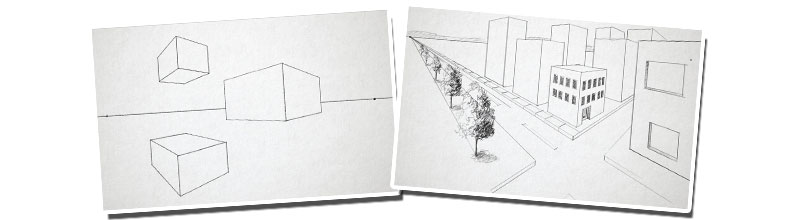
Linear perspective is one of the six ways to create the illusion of infinite on a two-dimensional surface. All forms of linear perspective involve the horizon line, vanishing point(southward), and lines of perspective that recede or accelerate to the vanishing betoken(due south). Each class of linear perspective is named for the number of vanishing points used in the drawing. Therefore, 2 signal perspective uses 2 vanishing points.

How Two Point Perspective Works in a Nutshell
Two point perspective starts past defining the horizon line. This line theoretically represents the line that divides the heaven from the ground. However, with many perspective drawings, this line is implied and instead represents the heart-line or "line of sight" of the viewer.
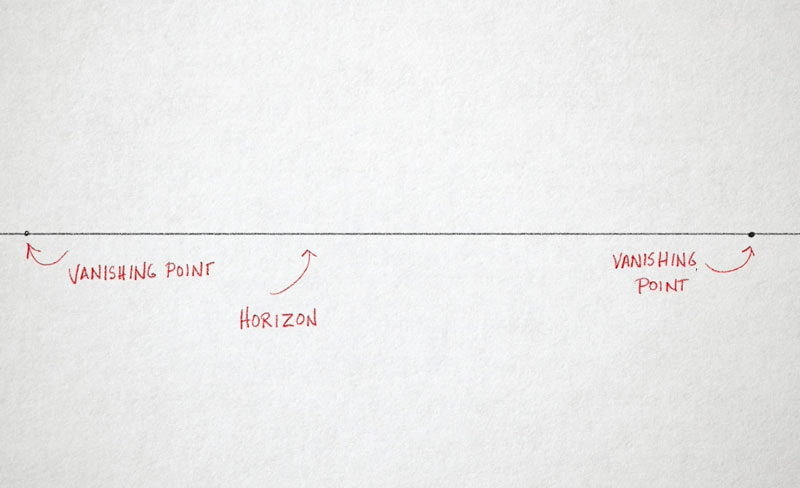
Once the horizon line has been established, the vanishing points are placed. The vanishing point is divers every bit a point placed on the horizon line where objects begin to disappear because of altitude. A skilful style to think of the vanishing point is by imagining yourself continuing on a embankment. Looking both directions, y'all tin can see endlessly down the beach. At some point, people on the beach walking abroad from y'all will get progressively smaller until they completely disappear at the horizon line.
With ii point perspective, 2 vanishing points are placed on the horizon line. These two points should be spaced out from each other to prevent distortion. Both vanishing points need not both be within the picture plane, but as long every bit they are found on the horizon line, which continues on off of the flick plane in both directions.
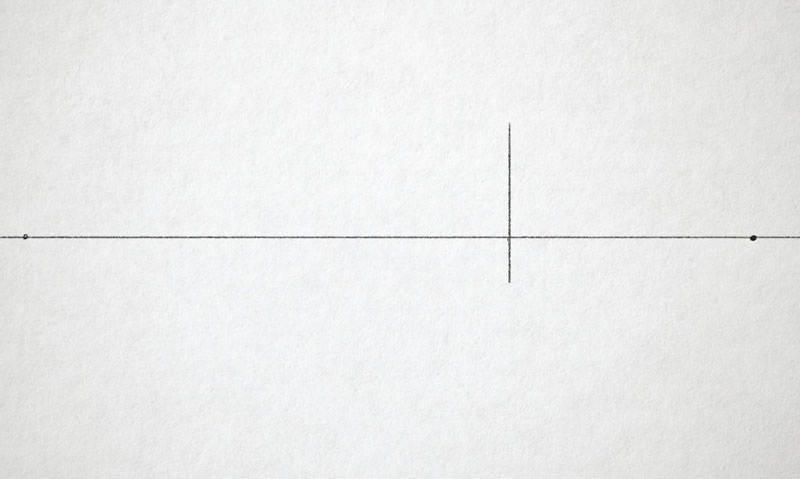
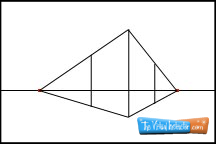
The next step is to draw the corner of the object. Most commonly, two indicate perspective is used for drawing buildings or interiors, and then this line could exist the corner of a building. This line is drawn in betwixt the two vanishing points and can cross over the horizon line.
Receding lines are side by side fatigued from each terminate of the corner to each one of the vanishing points. These lines are called orthogonal lines. Any set of parallel lines that recede away from the viewer will follow along these lines to i of the vanishing points.
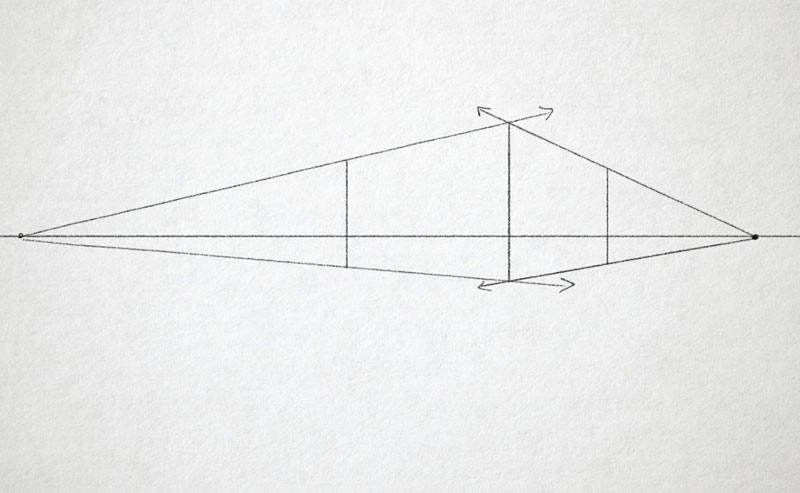
Parallel, vertical lines are drawn to bespeak where the edifice or course ends. The closer that these lines are placed in space to the vanishing points on either side, the longer the class appears.
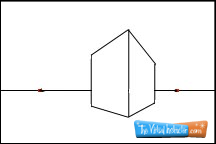
When a class is placed so that it overlaps the horizon, no boosted lines are needed to define the overall form of the object. Even so, information technology is important to note that additional lines practise exist. These lines are visible when the subject is placed to a higher place the horizon line or below it.
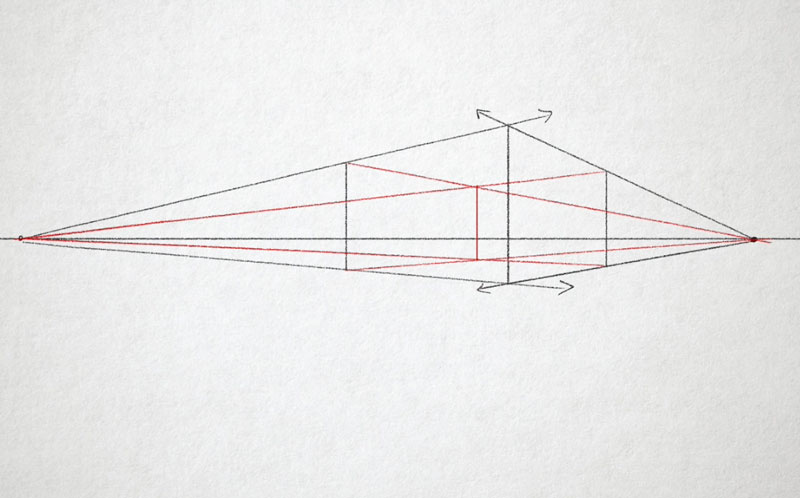
Orthogonals extend out from each end of the course and line upward with the opposite vanishing point. The location of intersection that occurs defines the the dorsum corner of the cube, which is drawn using a vertical line.
Beneath the Horizon Line
For forms placed below the horizon line the steps remain the same. Even so, the top of the class volition be visible. This means that the top portion of the class will be defined by the orthogonal lines that extend from each end to the opposite vanishing indicate.
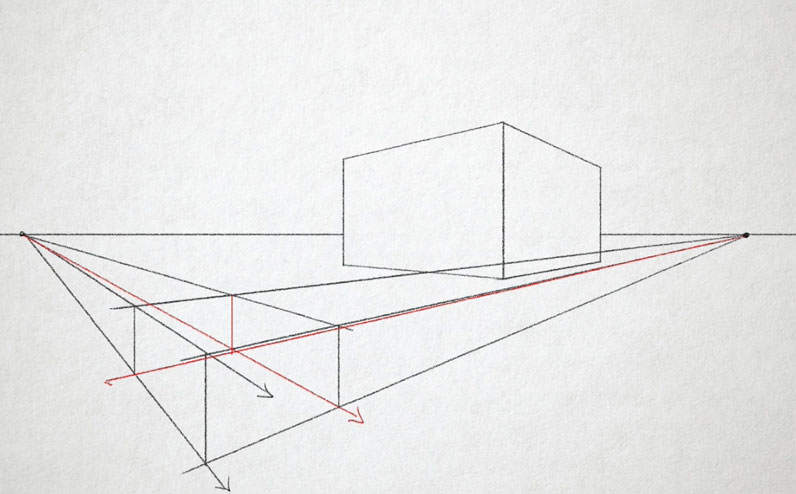
Here once again, some of the lines are not visible in the finished cartoon (red lines). It is important to note that the locations of where these lines intersect define the dorsum corner of the cube.
Above the Horizon Line
For forms placed to a higher place the horizon line, the same steps are followed. In this instance, the bottom portion of the form is at present visible to the viewer. The lesser portion is divers by extending lines from each finish of the cube to the opposite vanishing point.
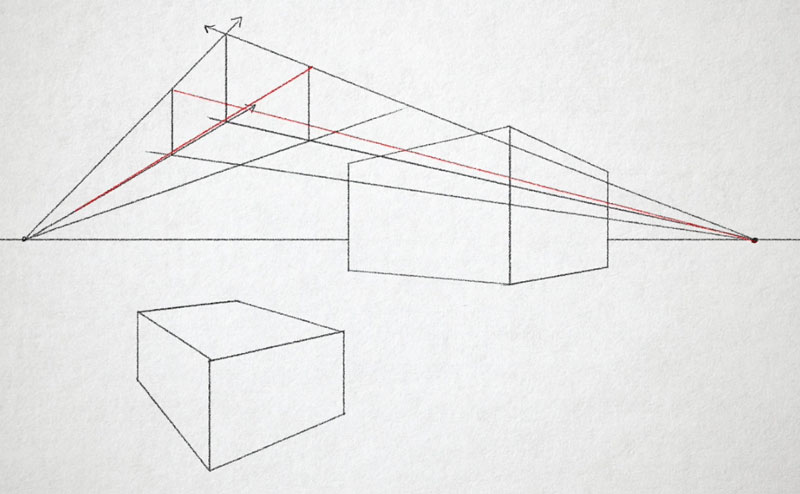
As is the case with the other examples, additional lines (red lines) exist but are not visible in the finished drawing. When complete, all lines that are no longer needed can be erased revealing the illusion of 3D forms in space.
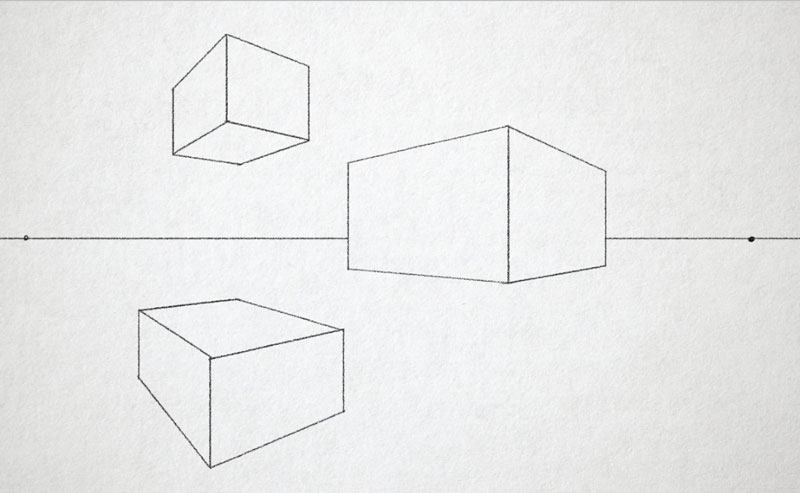
Adding Additional Details
Additional details can be added to a scene to create limitless possibilities. Vertical lines are drawn to indicate edges and corners, while orthogonal lines are fatigued for parallel edges that recede into space.
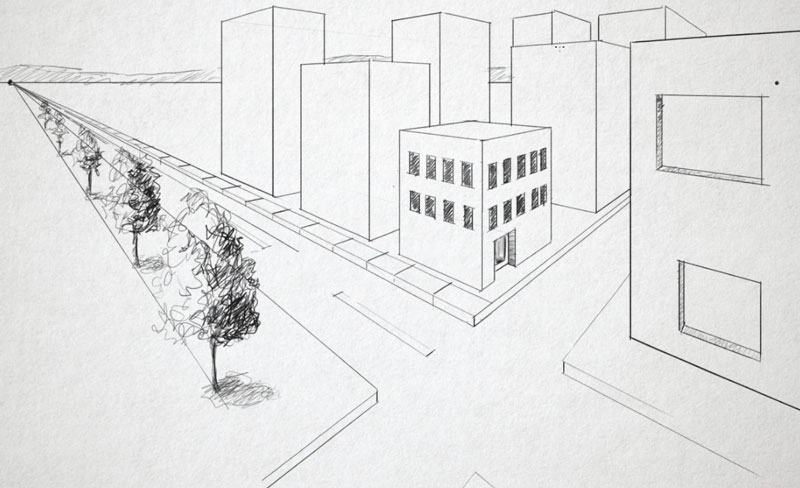
Run across also: How to Draw a 3D Maze with Two Bespeak Perspective
Which Type of Perspective Should Be Used?
The blazon of linear perspective used by the creative person depends largely on the vantage signal of the viewer. If the view of most of the geometric shapes in the scene are "apartment", then one point perspective may be the all-time choice. If the corners of objects are prevalent, then ii point perspective may be the all-time solution. If the view is extreme, from higher up or below, then the best selection may be to use iii point perspective.
Simple Breakdown of a Class Placed on the Horizon Line
Footstep One: Define the horizon line and the vanishing points.
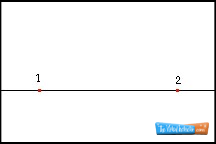
Footstep Ii: Draw the corner of the object in betwixt the vanishing points.
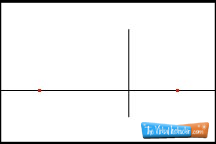
Pace Three: Draw lines from each end of the corner to each of the vanishing points.
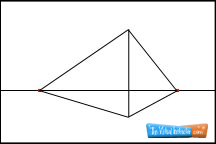
Stride 4: Draw parallel, vertical lines to indicate where the object ends.
Step Five: Erase the lines you no longer need to reveal your 3D form.
Source: https://thevirtualinstructor.com/twopointperspective.html
0 Response to "How to Draw a Plane in Two Point Perspective"
Publicar un comentario