â€å“i Puked at Joe Beef and It Made Me a Better Manã¢â‚¬â
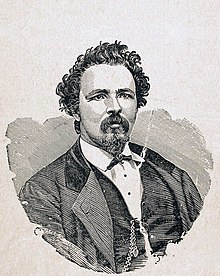
Charles McKiernan (four December 1835 Canton Cavan, Ireland – 15 January 1889, Montreal, Quebec, Canada) was a well-known Irish-Canadian Montreal tavern owner, innkeeper and philanthropist.
Biography [edit]
Charles McKiernan earned the sobriquet "Joe Beef" from his time as a Quartermaster with the 10th brigade in the British Army during the Crimean State of war. Whenever his regiment was running low on nutrient, McKiernan had a knack of somehow finding meat and provisions, hence the name "Joe Beef"[ citation needed ].
The human, who would become famous in Montreal equally a gruff philanthropist, came to the city around 1864 equally a part of his artillery regiment. After advancing to Sergeant, he was put in charge of the main military canteen on Saint Helen's Island. Discharged in 1868, he opened "Joe Beefiness's Tavern," an inn and tavern soon known throughout North America, located at Nos 4, 5, 6 Common St, Montreal in what is at present Old Montreal. Beefiness refused service to no ane, telling a reporter, "no affair who he is, whether English, French, Irish, Negro, Indian, or what religion he belongs to". Every twenty-four hours at noontime, hundreds of longshoremen, beggars, odd-job men and outcasts from Montréal club showed upward at his door.[1] The clientele of the tavern was mostly working class. Canal labourers, longshoremen, sailors, and ex-army men like McKiernan himself were mainstays of the business. For working grade Montreal, McKiernan's tavern functioned as the centre of social life in Griffintown. At the time, the neighbourhood had no public parks, and gatherings and public celebrations were only occasionally held past national societies and church groups.[ii] Thus, daily recreational activities were centered around Joe Beefiness'due south Canteen.
An atheist, Beef had the following manifesto printed on handbills and advertisements:
He cares not for Pope, Priest, Parson, or King William of the Boyne; all Joe wants is the Money. He trusts in God in summertime time to go on him from all harm; when he sees the commencement frost and snow poor old Joe trusts to the Almighty Dollar and good onetime maple wood to keep his belly warm, for Churches, Chapels, Ranters, Preachers, Beechers and such stuff Montreal has already got enough.[three]
The New York Times was not impressed, however, calling Joe Beef's Bottle "a den of filth" and writing that:
The proprietor is evidently an educated homo, and speaks and writes well. But he is a little nearer a devil and his place nearly what the revised version calls Hades than anything I ever saw.[4]
Beef was known for keeping a menagerie of animals in his tavern, including iv black bears, ten monkeys, iii wild cats, a porcupine and an alligator. The bears were commonly kept in the tavern'due south cellar and viewed by customers through a trap door in the barroom floor. He sometimes brought a bear up from the basement to restore order in his tavern, to fight with his dogs or play a game of billiards with the proprietor. One of his bears, Tom, had a daily consumption of twenty pints of beer and would sit on his hindquarters and hold a drinking glass betwixt his paws without spilling a drop. On one occasion, McKiernan was mauled by a buffalo on exhibit and was sent to hospital for a number of days.[5] Another fourth dimension, a Deputy Clerk of the Peace was inspecting the tavern in gild to renew the license and was bitten past one of McKiernan's dogs.
He ran his tavern from 1870 until his death from a centre attack in 1889, at the historic period of 54.[six]
Funeral [edit]
At his funeral, every office in the business district airtight. Fifty labour organizations walked off the job while Joe Beef'southward casket was drawn through the city by an ornate four-horse hearse, in a procession several blocks long. The paper La Minerve reported:
The crowd consisted of Knights of Labour, workers and manual labourers of all classes. All the luckless outcasts to whom the innkeeper-philanthropist had so ofttimes extended a helping hand had come up forward, eager to pay a last tribute to his memory".[i]
He is buried in the Mount-Royal Cemetery and his funeral monument, on plot B 991e, bears a long epitaph which testifies to the gratitude of his family and friends,
Legacy [edit]
Despite a lack of formal education, McKiernan considered himself an intellectual and was an avid reader. He engaged in heated debates on the topics of the day and was a champion for the rights of the common man. He entertained the crowds with poetry and humorous stories which lampooned the figures of authority in the workingman's life, such as the employer, the landlord, or the local church minister. He acted as an abet for the working grade population of Griffintown and played an important role in the Lachine Canal workers strike of 1877. He provided them with iii,000 loaves of breadstuff and 500 gallons of stew, and paying the travel expenses of their delegation to Ottawa.[v] As they set off, he addressed a oversupply of 2,000 in front of his tavern with a rousing speech "delivered in rhymed endings which was heartily applauded."[1] He also assisted strikers at the due east-finish Hudon material manufacturing plant on 26 Apr 1880.
As the focal point of social life in Griffintown at the time, Joe Beef's Canteen provided early on social services such every bit housing, food, and casual employment for the poor and downtrodden.
He was a fundamental grapheme in a play by David Fennario, entitled Joe Beef.
McKiernan was the inspiration behind Joe Beef Eating house, which opened in 2005 on Notre Dame Street West in the neighbourhood of Piddling Burgundy and was selected equally the 81st best eating house in the world in 2016 by fifty World's All-time Restaurants, the first Canadian restaurant to make the list in six years[ commendation needed ].
Business [edit]
His net worth in January 1889 was $80,000 which had accumulated through the Inn and tavern primarily. At the top of operations at that place were revenues in excess of $720 on just beer solitary.
References [edit]
- ^ a b c "Montréal'due south – Saloon Santa Claus". Tourisme Montréal. Archived from the original on 8 December 2007. Retrieved 24 March 2008.
- ^ Chocolate-brown, James D. & Hannis, David. (2008). Customs Development in Canada. Toronto: Pearson Educational activity Canada.
- ^ Glenn F. Cartwright (25 Dec 2003). "Joe Beef of Montreal". McGill University. Archived from the original on 7 Oct 2008. Retrieved 21 Nov 2008.
- ^ "THE CANADIAN VOYAGEUR Continuing THE DESCENT OF THE ST. LAWRENCE". The New York Times. xx August 1881. Retrieved 21 Nov 2008.
- ^ a b DeLottinville, Peter. (2006). Joe Beef of Montreal: Working-Grade Culture, Customs, and the Tavern, 1869–1889. In R. Douglas Francis & Donald B. Smith (Eds.), Readings in Canadian History: Post-Confederation (pp. 370–390). Toronto: Thomson.
- ^ "Griffintown and Signal Saint Charles: Heritage Trail" (PDF). Quebec Anglophone Heritage Network. Archived from the original (PDF) on 2 July 2006. Retrieved 23 March 2008.
Source: https://en.wikipedia.org/wiki/Joe_Beef
0 Response to "â€å“i Puked at Joe Beef and It Made Me a Better Manã¢â‚¬â"
Publicar un comentario